
Calculations follow commonly used HSE practices. Always confirm with your organization’s definitions and local regulations. References: OSHA 1904, ISO 45001, ILO OSH.
The TRIR Calculator helps you calculate the Total Recordable Incident Rate (TRIR) using OSHA’s standard formula for safety performance reporting.
Inputs
Enter details, preview, and export to PDF.
Project / Site
Load Example
One click fills realistic values for all inputs.
Note: What data you need & definitions
Data you need
- Total man-hours for the period (employees + contractors; include OT).
- TRC (Total Recordable Cases) for the same period (MSD + MTI + RWC + LTI).
- Accidents for AFR (your institutional “accident” definition—commonly reportable incidents).
- Fatalities for FAR (work-related deaths in the period).
- Rate bases: keep consistent across periods for comparability.
Formulas
TRIR = (TRC × Base) ÷ Man-Hours (Base commonly 200,000)
AFR = (Accidents × Base) ÷ Man-Hours (Base commonly 1,000,000)
FAR = (Fatalities × Base) ÷ Man-Hours (Base commonly 1,000,000 or 100,000,000)
Quick ways to get man-hours
- Sum of timesheets/payroll.
- Access/turnstile logs × avg productive hours.
- Crew roster estimate: Σ (crew size × hrs/day × days × shifts).
Total Man-Hours
TRIR (Total Recordable Incident Rate)
Formula: TRIR = (TRC × Base) ÷ Man-Hours
AFR (Accident Frequency Rate)
Formula: AFR = (Accidents × Base) ÷ Man-Hours
FAR (Fatal Accident Rate)
Formula: FAR = (Fatalities × Base) ÷ Man-Hours
TRIR / AFR / FAR Report
Generated preview — review and export to PDF
Generated On
Project / Site: —
Client: —
Location: —
Period: —
Rates = (Count × Base) ÷ Man-Hours
TRIR
0.00
TRC: 0 · Base: 200,000
AFR
0.00
Accidents: 0 · Base: 1,000,000
FAR
0.00
Fatalities: 0 · Base: 1,000,000
📊 TRIR Calculator – Complete Guide
In occupational health and safety (HSE), organizations must track more than just incident counts — they must also normalize safety performance so that it can be compared across projects, companies, or industries.
This is where TRIR (Total Recordable Incident Rate), AFR (All Injury Frequency Rate), and FAR (Fatal Accident Rate) come in.
These standardized indicators allow safety professionals to measure the rate of recordable incidents, injuries, and fatalities relative to workforce size and exposure hours, making safety data comparable across organizations.
✅ What Are TRIR, AFR, and FAR?
🔹 Total Recordable Incident Rate (TRIR)
TRIR measures the number of OSHA recordable incidents (including fatalities, lost time, restricted work, and medical treatment cases) per 200,000 man-hours worked.
- Used mainly in the USA (OSHA standard).
🔹 All Injury Frequency Rate (AFR)
AFR measures the number of all work-related injuries (fatalities + LTIs + MTCs + restricted work cases) per 1,000,000 man-hours worked.
- Commonly used in the UK, Europe, and Middle East.
🔹 Fatal Accident Rate (FAR)
FAR measures the number of fatalities per 100,000,000 man-hours worked.
- Designed to capture the rarity but severity of workplace fatalities.
📐 Formulas
TRIR Formula
TRIR = (Total Recordable Cases × 200,000) ÷ Total Man-Hours Worked
AFR Formula
AFR = (Total Injuries × 1,000,000) ÷ Total Man-Hours Worked
FAR Formula
FAR = (Total Fatalities × 100,000,000) ÷ Total Man-Hours Worked
👉 Multipliers (200,000 / 1,000,000 / 100,000,000) standardize results so organizations of all sizes can be compared fairly.
🛠 How to Use the TRIR Calculator
- Enter Total Man-Hours Worked
- Include employees + contractors.
- Enter Incident Counts
- TRIR → Total recordable incidents
- AFR → All work-related injuries
- FAR → Fatalities
- Click Calculate
- Get standardized safety performance rates.
💡 Pro Tip: Use all three metrics together for a complete picture of safety culture.
📊 Example Calculations for TRIR Calculator
Example 1 – TRIR (Construction Project)
- Total Recordable Cases: 6
- Man-Hours: 2,400,000
- TRIR = (6 × 200,000) ÷ 2,400,000 = 0.5
Example 2 – AFR (Manufacturing Plant)
- Total Injuries: 15
- Man-Hours: 5,000,000
- AFR = (15 × 1,000,000) ÷ 5,000,000 = 3
Example 3 – FAR (Oil & Gas Site)
- Fatalities: 1
- Man-Hours: 50,000,000
- FAR = (1 × 100,000,000) ÷ 50,000,000 = 2
📌 Why Are TRIR, AFR, and FAR Important?
- Standardization → Enables benchmarking across industries.
- Regulatory Compliance → OSHA, ILO, and ISO standards.
- Client & Tender Requirements → Many bids require TRIR/FAR history.
- Performance Monitoring → Identifies trends in safety performance.
- Reputation Management → A low TRIR/FAR signals strong safety culture.
🏗️ Real-World Examples
- Metro Rail Project → TRIR of 0.7 in 5M hours.
- Oil Refinery Turnaround → AFR of 4 in 10M hours.
- Wind Farm Construction → FAR of 0 in 12M hours (excellent performance).
🔍 Common Mistakes in Tracking
- Using total headcount instead of total hours worked.
- Not including contractors’ hours/incidents.
- Mixing up TRIR (200,000 base) with AFR (1,000,000 base).
- Recording first-aid cases as recordable incidents.
📌 Best Practices to Improve TRIR / AFR / FAR
- Conduct proactive risk assessments (HIRA & JSA).
- Enforce Permit-to-Work (PTW) for high-risk tasks.
- Regular toolbox talks and targeted training.
- Monitor leading indicators (near misses, unsafe acts).
- Encourage open reporting without blame culture.
❓ Frequently Asked Questions (FAQ)
Q1: What’s the difference between TRIR and AFR?
TRIR uses 200,000 hours (OSHA standard). AFR uses 1,000,000 hours (global).
Q2: Why does FAR use 100,000,000 hours?
Because fatalities are rare; scaling helps show meaningful results.
Q3: Can TRIR / AFR / FAR be zero?
Yes ✅. A zero rate means no recordables/injuries/fatalities in the period.
🎯 Final Thoughts
The TRIR, AFR, and FAR are cornerstone KPIs in global safety reporting.
They don’t just count incidents — they normalize performance across industries and projects, helping organizations monitor, benchmark, and continuously improve.
By using our free TRIR Calculator, you can:
- Standardize your reporting.
- Meet client and compliance requirements.
- Benchmark your safety culture against industry peers.
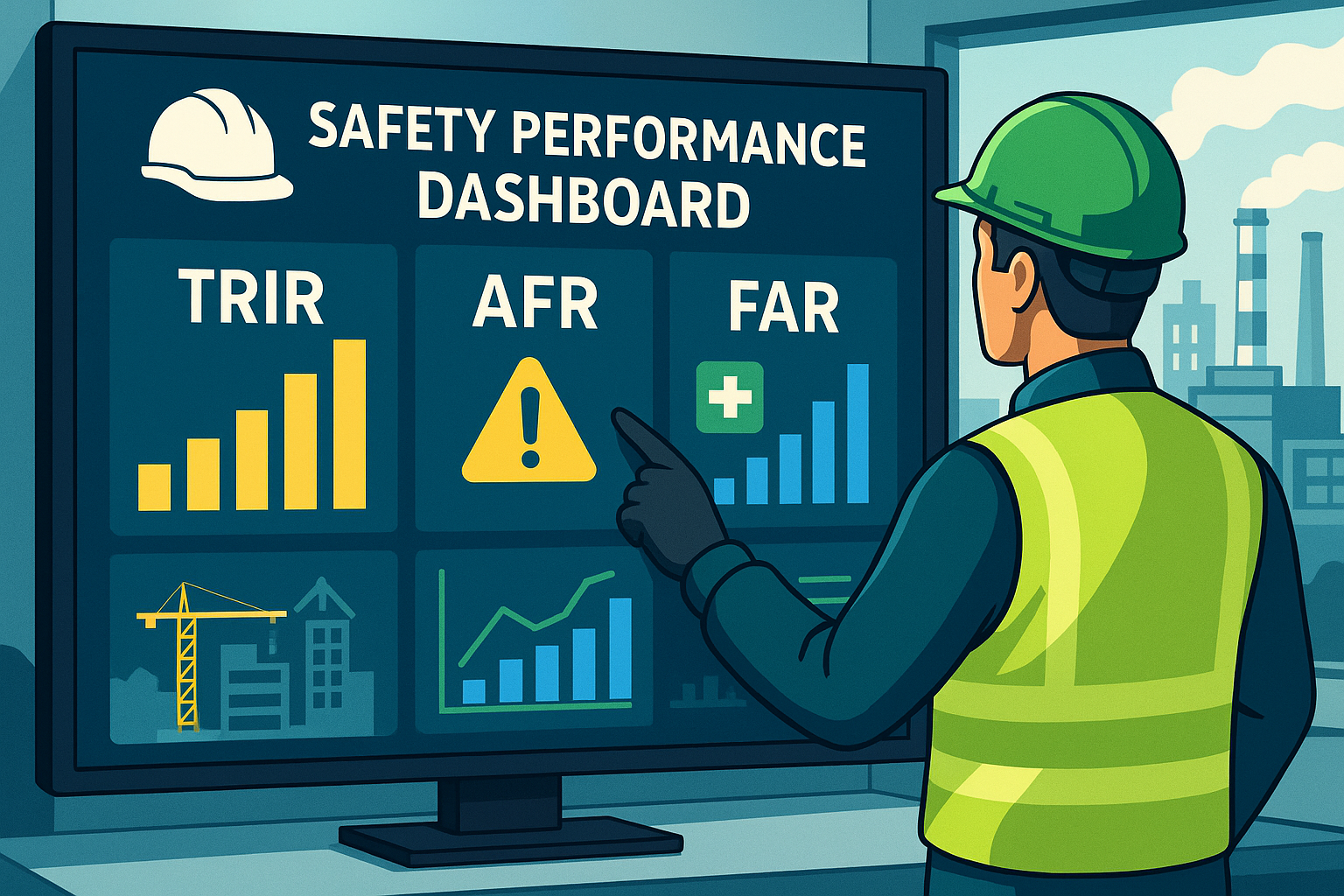
💡 Pro Tip: Don’t use these metrics in isolation. Combine them with LTIs, FR, SR, and Safe Man-Hours for a complete Safety Performance Dashboard.
👉 [Explore All Tools Here]
👉 [Open HIRA Generator]
👉 [Open JSA Generator]