
Calculations follow commonly used HSE practices. Always confirm with your organization’s definitions and local regulations. References: OSHA 1904, ISO 45001, ILO OSH.
The Total Lost Time Injury Calculator is a simple yet powerful tool that helps safety professionals measure LTIs accurately for compliance and reporting.
Inputs
Fill details, add LTI rows, preview, and export to PDF.
Project / Site
Load Example
These pre-fill realistic values so students can see how each section is completed.
Note for students: What counts as an LTI & what to record
- LTI definition: A work-related injury/illness that causes the worker to miss at least one full scheduled workday after the day of the incident.
- Record for each case: Date of incident, department/crew, days lost (calendar or scheduled days per your policy), and a short note.
- Do not include: first-aid only cases, no-lost-time medical treatment, or near misses (unless your policy requires separate tracking).
- Totals produced here: number of LTI cases, total days lost, average days lost per LTI.
LTI Cases
| Date | Department / Crew | Days Lost | Note | Remove |
|---|---|---|---|---|
| Total LTIs | 0 | Total Days Lost | 0 | |
Total Lost Time Injury (LTI) Report
Generated preview — review and export to PDF
Generated On
Project / Site: —
Client: —
Location: —
Period: —
LTI = Injury with ≥ 1 day lost after incident day
Total LTI Cases
0
Total Days Lost
0
Avg Days Lost / LTI
0.00
LTI Cases (This Period)
| Date | Department / Crew | Days Lost | Note |
|---|
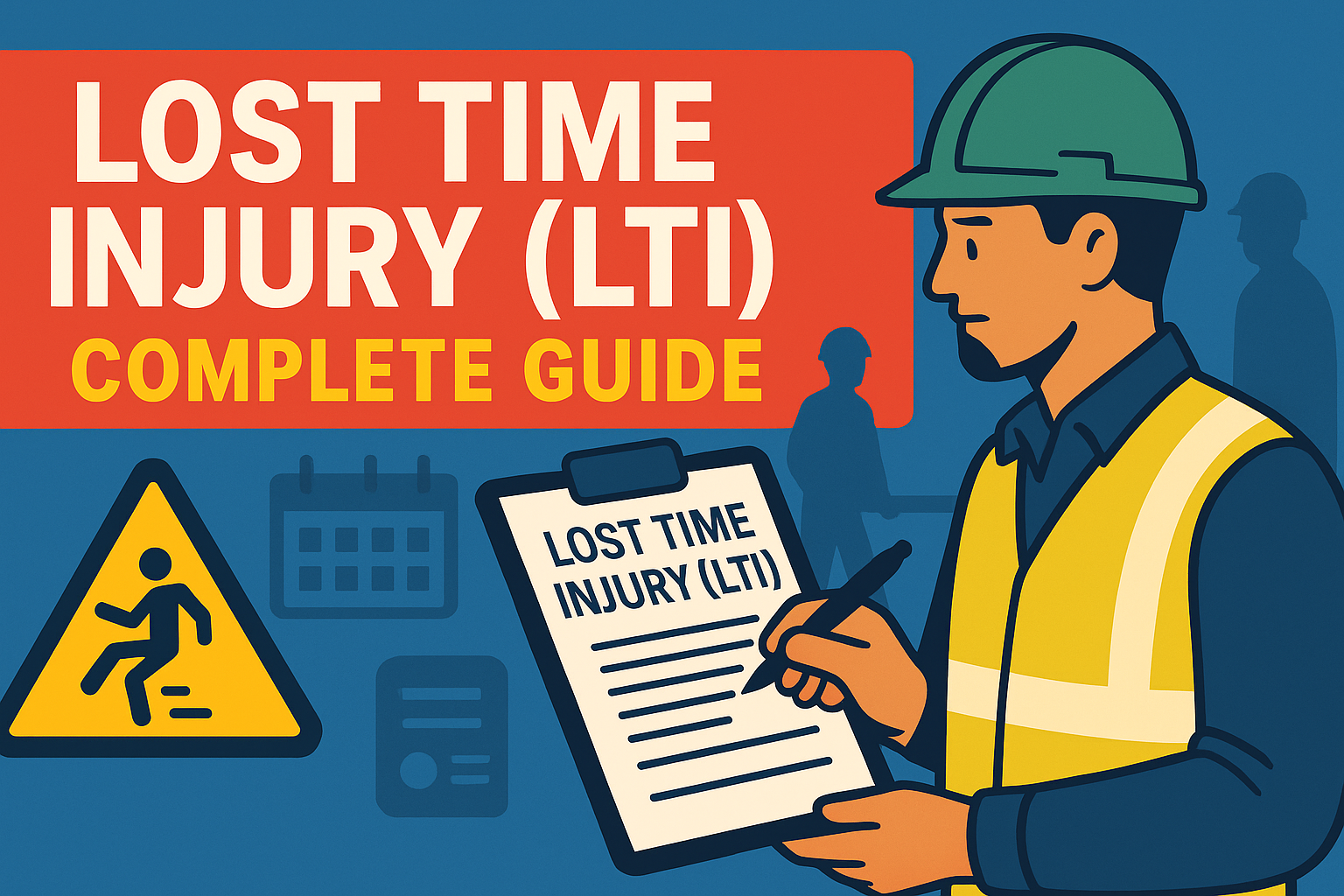
⚠️ Total Lost Time Injury Calculator – Complete Guide
In occupational health and safety (HSE), one of the most crucial metrics to track is the Lost Time Injury (LTI).
An LTI occurs when a worker suffers a work-related injury or illness that results in time away from work beyond the day of the incident.
The Total LTI Calculator helps organizations measure the absolute number of LTIs over a defined period, usually a month, quarter, or year.
This indicator is essential for tracking safety performance, meeting compliance requirements, and demonstrating commitment to workplace safety.
✅ What Is Lost Time Injury (LTI)?
A Lost Time Injury is any work-related incident that causes a worker to be unable to perform their duties for at least one full shift or more after the incident.
Examples:
- Fractures requiring recovery leave.
- Burns that keep an employee from returning to work.
- Severe sprains/strains needing time off.
⚠️ Note: First aid cases and medical treatment cases (MTC) are not LTIs unless they result in lost time.
📐 Formula for Total LTI
Unlike IR, FR, or SR, the Total LTI is a direct count:
Total LTI = Number of incidents where employees lost at least 1 full work shift/day due to injury or illness.
👉 No multipliers (200,000 or 1,000,000) are applied here — it’s a simple count.
🛠 How to Use the Total Lost Time Injury Calculator
- Enter Number of LTIs
- Count only incidents with lost time beyond the day of occurrence.
- Enter Time Period
- Choose the reporting period (monthly, quarterly, yearly, project-based).
- Click Calculate
- Get the total number of LTIs for the defined period.
💡 Pro Tip: Use this value in combination with Frequency Rate (FR) and Incident Rate (IR) for better insights.
📊 Example Calculations for Total Lost Time Injury Calculator
Example 1 – Construction Project
- LTIs: 5
- Period: 12 months
👉 Total LTI = 5
Example 2 – Manufacturing Plant
- LTIs: 2
- Period: 6 months
👉 Total LTI = 2
Example 3 – Oil & Gas Site
- LTIs: 0
- Period: 3 months
👉 Total LTI = 0 (excellent safety performance)
📌 Why Is Tracking LTI Important?
✔ Performance Monitoring → Shows how many serious incidents led to lost work time.
✔ Compliance → Many regulators (OSHA, ILO, ISO 45001) require tracking LTIs.
✔ Client Reporting → Tender documents often ask for LTI history.
✔ Benchmarking → A high LTI count reflects poor safety culture; a low count indicates strong safety management.
🏗️ Real-World Examples
- Metro Rail Project → 3 LTIs in 10M man-hours.
- Oil Refinery Turnaround → 8 LTIs in 25M man-hours.
- Wind Farm Construction → 0 LTIs in 5M man-hours.
🔍 Common Mistakes in Tracking LTIs
❌ Counting minor injuries with no lost days.
❌ Forgetting contractor injuries in reporting.
❌ Confusing LTIs with Medical Treatment Cases (MTC).
❌ Using working days lost instead of number of cases.
📌 Best Practices to Reduce LTIs
✔ Strong incident reporting system.
✔ Regular toolbox talks and safety induction training.
✔ Enforce PPE compliance at all levels.
✔ Proactive risk assessments and PTW system.
✔ Encourage near-miss reporting to prevent escalation into LTIs.
❓ Frequently Asked Questions (FAQ)
Q1: What qualifies as an LTI?
→ Any incident causing at least 1 full work shift/day off after the day of injury.
Q2: Are fatalities included in LTIs?
→ Fatalities are tracked separately but also reported as the most severe type of LTI.
Q3: Can LTI be zero?
→ Yes ✅, if no incidents resulted in lost time during the reporting period.
🎯 Final Thoughts
The Total LTI is one of the simplest yet most important KPIs in safety management.
It tells you how many serious injuries caused work absence, and when tracked over time, it provides a clear picture of safety performance.
By using our free Total Lost Time Injury Calculator, you can:
✔ Quickly calculate LTIs for any reporting period.
✔ Include accurate data in compliance and client reports.
✔ Benchmark and improve safety culture across projects.
💡 Pro Tip: Don’t stop at counting LTIs. Combine this KPI with FR, SR, IR, and Safe Man-Hours for a complete Safety Performance Dashboard.
👉 [Explore All Tools Here]
👉 [Open HIRA Generator]
👉 [Open JSA Generator]
External Links: