
Calculations follow commonly used HSE practices. Always confirm with your organization’s definitions and local regulations. References: OSHA 1904, ISO 45001, ILO OSH.
Checklist Inputs
Fill the form, preview, and export to PDF.
Session
Checklist Items
OK: 0 N/A: 0 Issues: 0| Category | Item | Status | Remarks / Controls | Remove |
|---|
Action Items (for any “Issue” rows)
| Action / Control Required | Owner | Due Date | Status | Remove |
|---|
Final Notes
Construction Safety Checklist — Report
Generated preview — review and export to PDF
Generated On
Project / Site: —
Location / Area: —
Conducted by: —
Date & Time: —
Company / Trade: —
Weather: —
Session Notes
—
OK
0
N/A
0
Issues
0
Checklist Results
| Category | Item | Status | Remarks / Controls |
|---|
Action Items
| Action / Control Required | Owner | Due Date | Status |
|---|
Final Notes
—
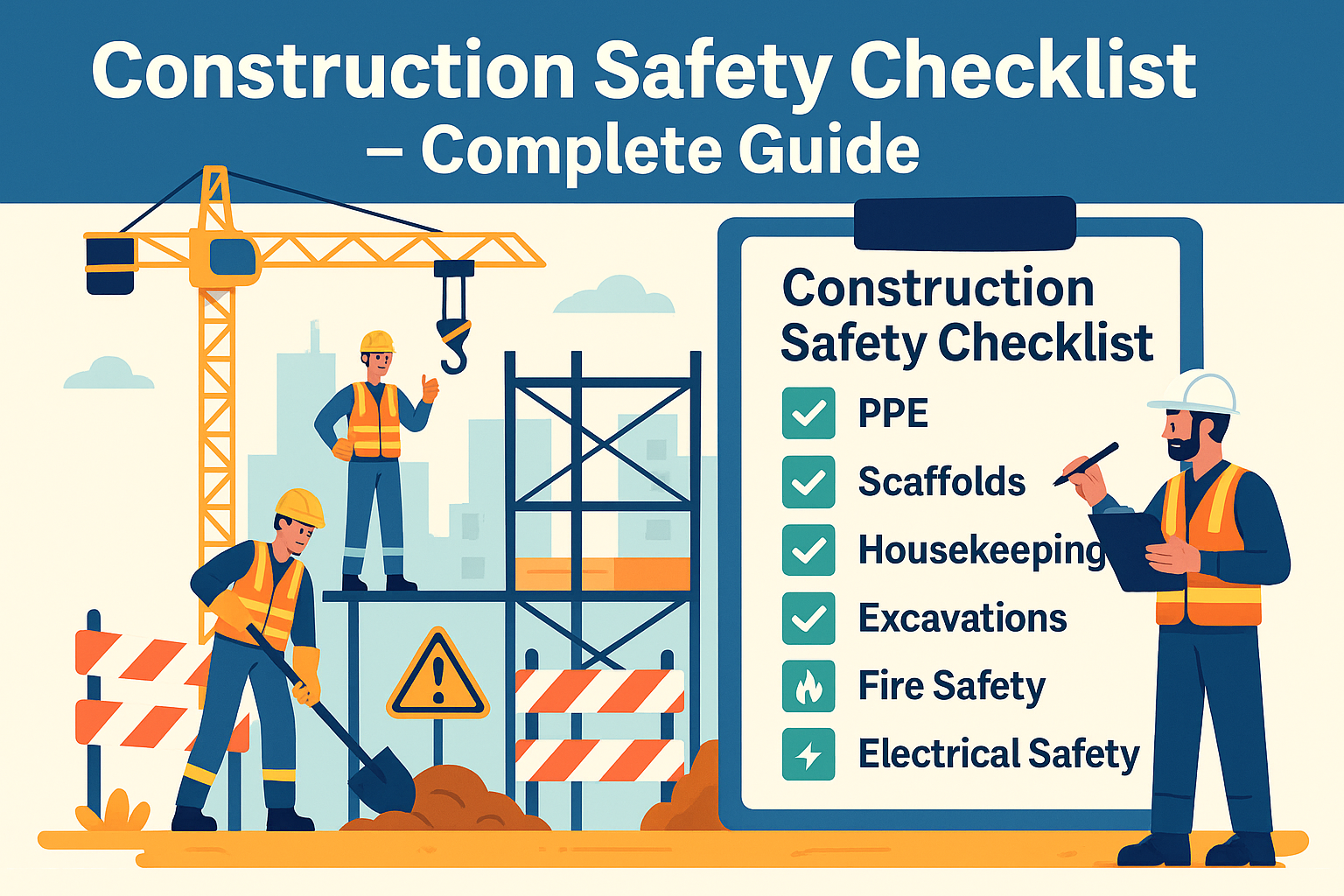
🏗️ Construction Safety Checklist – Complete Guide
Construction sites are among the most hazardous workplaces, with multiple activities such as excavation, scaffolding, hot work, lifting operations, and electrical installations happening simultaneously.
A Construction Safety Checklist is a structured inspection tool that ensures all critical safety elements are verified regularly.
By using this checklist, organizations can identify unsafe conditions, enforce compliance with OSHA/ILO/ISO 45001 standards, and most importantly, prevent accidents before they occur.
✅ What Is a Construction Safety Checklist?
A Construction Safety Checklist is a standardized document used by safety officers, site engineers, and supervisors to verify that safety controls are in place during site operations.
Examples of what it covers:
- Proper access and egress routes.
- Scaffolding safety checks.
- PPE compliance.
- Fire safety measures during hot work.
- Traffic management at site.
⚠️ Note: A checklist does not replace a risk assessment but supports day-to-day monitoring of site safety.
📋 Key Components of a Construction Safety Checklist
A comprehensive checklist generally includes the following categories:
- Access & Egress → Safe entry/exit routes, emergency exits, stairways.
- Housekeeping → Waste removal, material stacking, clear pathways.
- Working at Height → Guardrails, lifelines, anchorage points, fall protection.
- Scaffolds → Inspection tags, stability, proper planking, access ladders.
- Excavations → Shoring, benching, edge protection, safe access.
- Lifting & Rigging → Crane inspection, slings, shackles, load charts.
- Electrical/LOTO → Cords, panels, lockout-tagout in place.
- Hot Work/Fire Safety → Fire watch, extinguishers, permits, sparks control.
- PPE → Helmets, gloves, goggles, hi-vis vests, footwear.
- Traffic Management → Barricades, spotters, vehicle movement control.
🛠 How to Use the Construction Safety Checklist
- Fill in Site Details → Project name, location, contractor, inspector, date.
- Inspect Each Category → Tick ✅ for compliant, mark ❌ for non-compliant.
- Add Comments → Provide details on issues found and corrective actions.
- Summarize Findings → Total items checked, Passed vs Needs Action.
- Download/Record → Save as PDF or file in the safety management system.
💡 Pro Tip: Use digital versions with auto-generated PDF reports for efficiency.
📊 Example Usage
Example 1 – High-Rise Construction Project
- Issues Found: Missing guardrails on 10th floor, debris blocking stairway.
👉 Marked as “Needs Action” in checklist.
Example 2 – Road Project
- Issues Found: Traffic signs not placed, workers without reflective jackets.
👉 Action taken: Provided jackets & placed warning boards.
Example 3 – Oil & Gas Construction Site
- Issues Found: Fire extinguishers missing during welding.
👉 Issued stop-work until extinguishers provided.
📌 Why Is a Construction Safety Checklist Important?
✔ Ensures daily safety compliance with legal and company requirements.
✔ Helps identify unsafe acts and conditions before accidents happen.
✔ Provides a record for audits and client reporting.
✔ Boosts safety culture by involving supervisors and workers.
🏗️ Real-World Applications
- Metro Rail Projects → Used for daily scaffold and excavation inspections.
- Refinery Shutdowns → Hot work and confined space entries tracked via checklist.
- Commercial Buildings → Electrical checks and PPE compliance monitored weekly.
🔍 Common Mistakes in Using Checklists
❌ Treating the checklist as a “tick-box exercise” without actual inspection.
❌ Ignoring contractor/subcontractor compliance.
❌ Not closing actions identified during inspections.
❌ Overlooking temporary changes (e.g., site re-routing).
📌 Best Practices for Effective Checklists
✔ Customize checklist items to site-specific risks.
✔ Train supervisors on how to inspect properly.
✔ Use photos to support findings.
✔ Follow up on corrective actions until closure.
✔ Digitize the process for better tracking and analytics.
❓ Frequently Asked Questions (FAQ)
Q1: How often should a construction safety checklist be used?
→ Daily for high-risk activities, weekly for general site inspections.
Q2: Can contractors use their own checklists?
→ Yes, but they must align with site HSE standards and legal requirements.
Q3: Who is responsible for filling the checklist?
→ Usually the site safety officer, but supervisors and engineers can also participate.
🎯 Final Thoughts
The Construction Safety Checklist is a powerful preventive tool for keeping sites safe and compliant.
It helps safety officers and supervisors quickly identify issues, enforce corrective actions, and maintain high safety standards.
By using our free Construction Safety Checklist Tool, you can:
✔ Perform structured inspections with predefined categories.
✔ Auto-generate PDF reports for record-keeping.
✔ Enhance site safety culture and compliance with international standards.
💡 Pro Tip: Pair your checklist inspections with HIRA, JSA, and PTW systems for a complete safety management approach.
👉 [Explore All Tools Here]
👉 [Open HIRA Generator]
👉 [Open JSA Generator]
External Link: OSHA Construction Standards